Tuesday, 12 November 2013

yoma 3

how hands-on is making as opposed to taking?

whose hand pays when something is taken?

(this page continues to debate the connection between Yom Kippur temple service and the inauguration service of the Temple, both having a 7 day sequestering of the High Priest. other festivals than Yom Kippur are suggested but Yom Kippur the High Priest has to "take for yourself" implying that some of the offerings are paid for by him, not from the communal funds. but this is compared to "make for yourself"with other obligations and cannot be concluded that taking is the same as making when it comes to payment. It stuck me that when something is taken it is held tightly. but when it is made, obviously depending on the technique but in general the hand needs to slightly looser, allowing for the object to become it's own thing.)


yoma 2

lining up the replacement brides.

but how many can drop dead in a week? if it goes on for ever, that's a lot of dead women.

(both Yom Kippur and the ritual of the red heifer, require a preparation time of 7 days. part of which is to appoint a successor should the High Priest die suddenly. also planned is the High Priest's wife's replacement, should anything happen to the High Priest's wife. and then the replacement for the replacement etc....)

Monday, 11 November 2013

goodbye shekalim


from the message going out on the 1st of adar announcing the collection of the half-shekel, to the bitter reality that in a post-destruction world where the half-shekel is no longer used. The practicalities of collecting money from people who live scattered apart, from jerusalem and beyond, including Bavel, the place of exile - which is discussed on the first page, and the last page which faces up to a world without the Temple. But there is not cause for despair as there is on the last page some hope that the Temple will be rebuilt. This section of the Talmud is focused on the temple, it's donations and process of making things holy. But it concludes acknowledging that all that discussion is now over. It is practically irrelevant.

I decided to do this section of the Talmud in collage. it was a bit of a whim but has greatly affected how I reply to the text. Do I just make a pile of objects and images that are referring to in the learning? or to think differently about each page. some days I have felt that if only I was tackling this section in another way - pen & ink - then the drawings would have been much much quicker.... each section of the Talmud brings its own character. and this bit is quite strange. It is the Yerusalmi not the Bavli Talmud. a whole different style. and just as i got used to it, it was over.

oh well. onwards to Mesechet Yoma...


shekalim 22

inside or outside

the destruction makes the half shekel redundant for now
but keep it around, might be useful in the future.

(after discussing how and where to dispose of meat that has become impure, and where to place various offerings on the ramp in the Temple, this page discusses what happens to various obligations once the Temple is no longer present. Debated are the half-shekel and the first-fruits, and if they can become consecrated and kept waiting until the Temple is rebuilt.)

shekalim 21

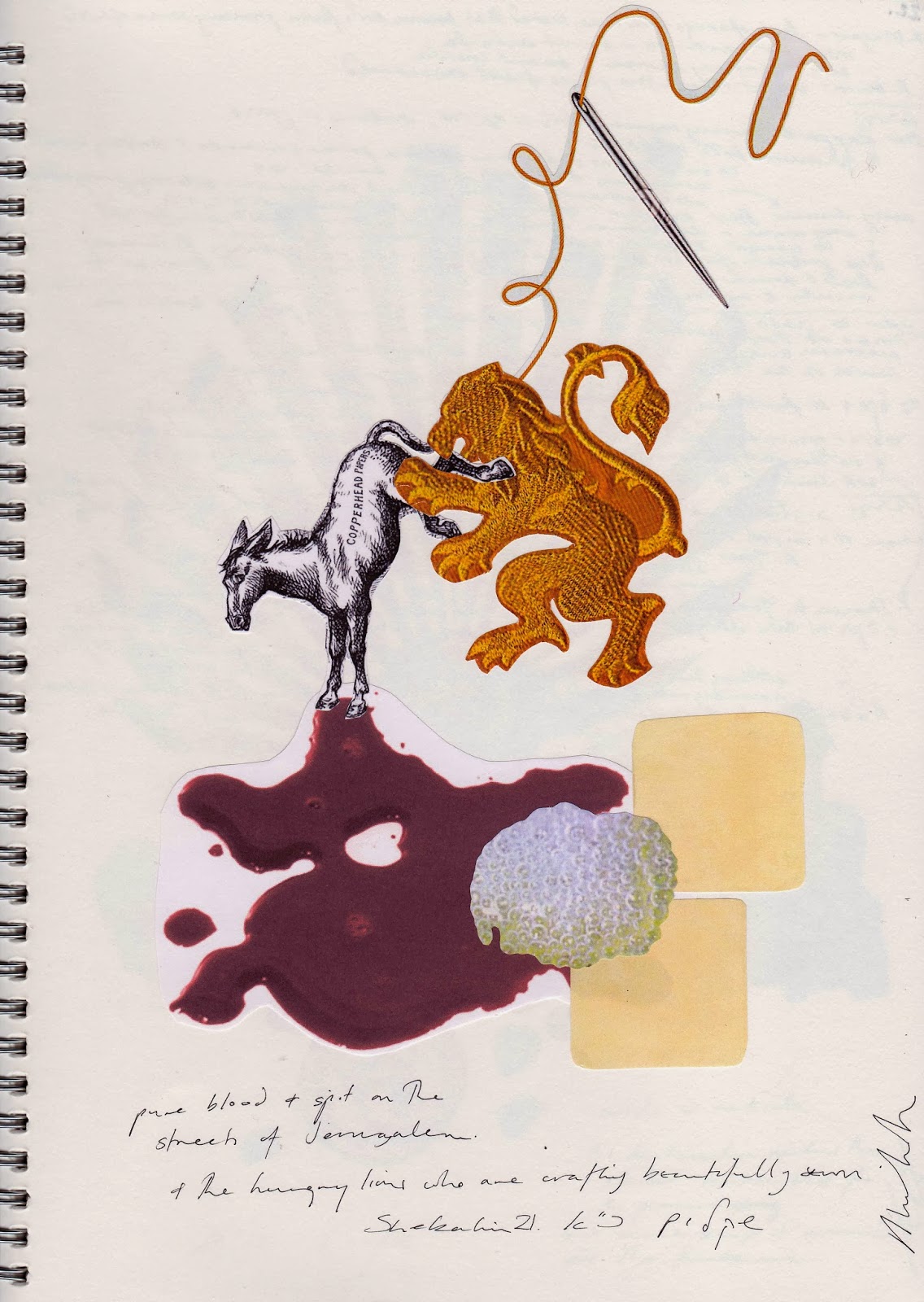
pure blood and spittle on the streets of Jerusalem

and the hungry lions who are beautiful embroidered.

(this page discuss if spittle is found on the streets on Jerusalem it is presumed to be from a pure person. this page also repeats the case about discussing the amount of blood from a carcass of a donkey - or is any amount of blood considered pure. the donkey's blood comes from the gentile part of jerusalem where donkeys were fed to lions. Lions also crop up at the end of the page in the description of the beauty and craft of the curtain covering the Holy of Holies.)

shekalim 20

throwing it all away

discarding meat, money and meal-offerings that have lost their identity and origins

shekalim 19

lost & found

finding money and meat in the street